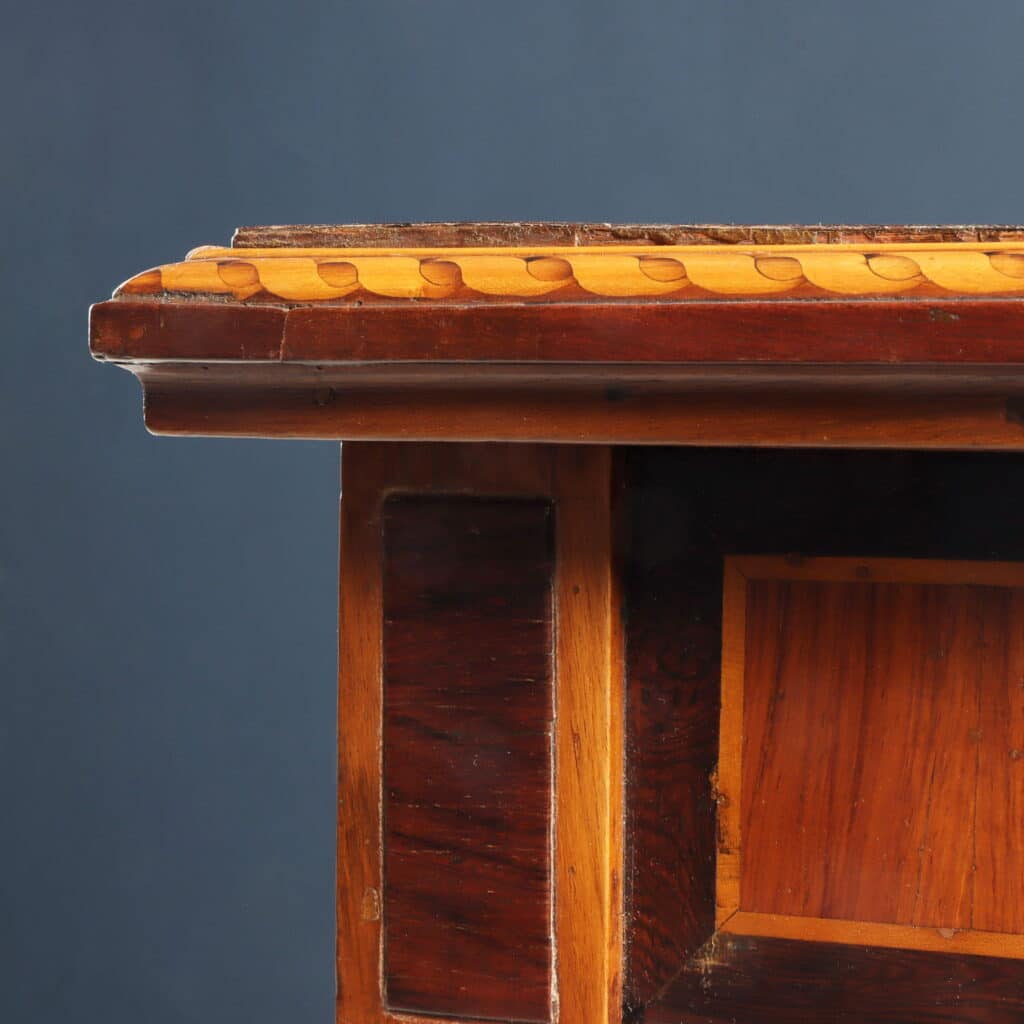
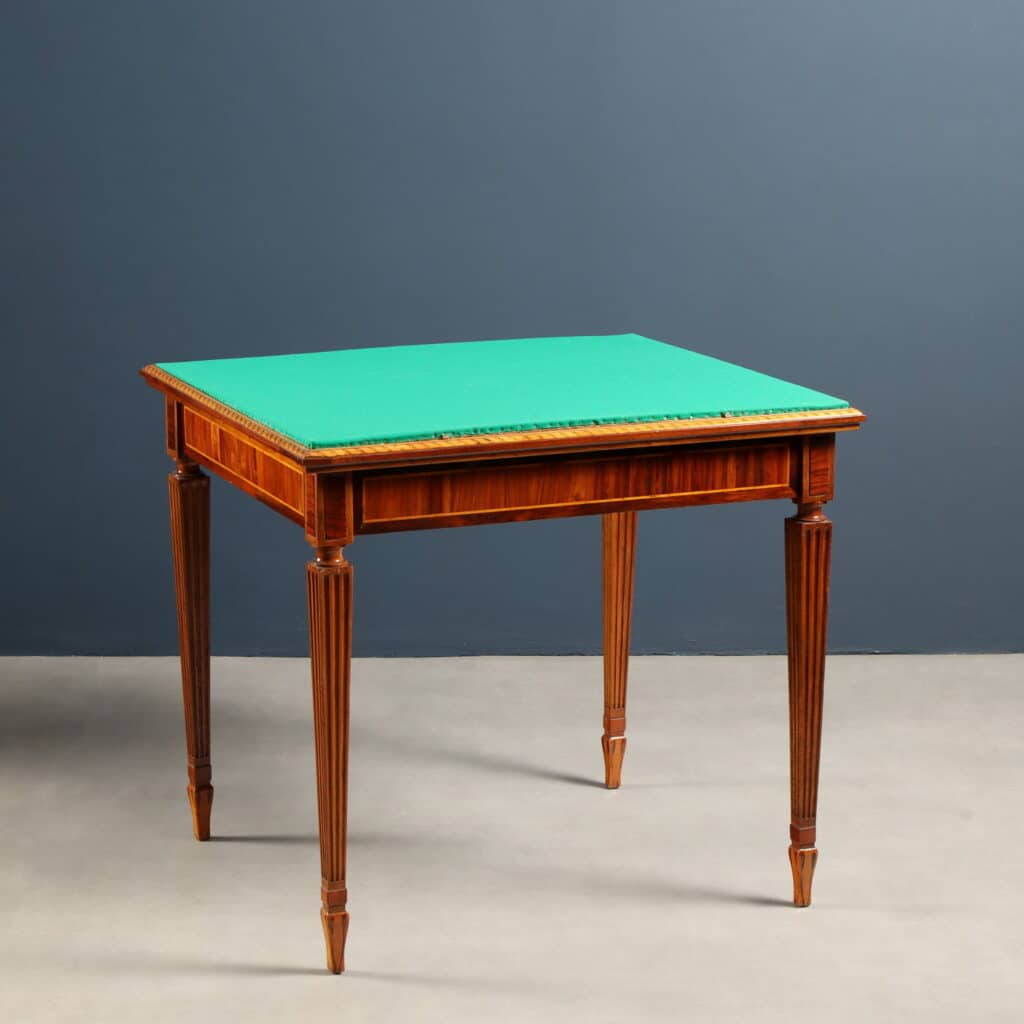
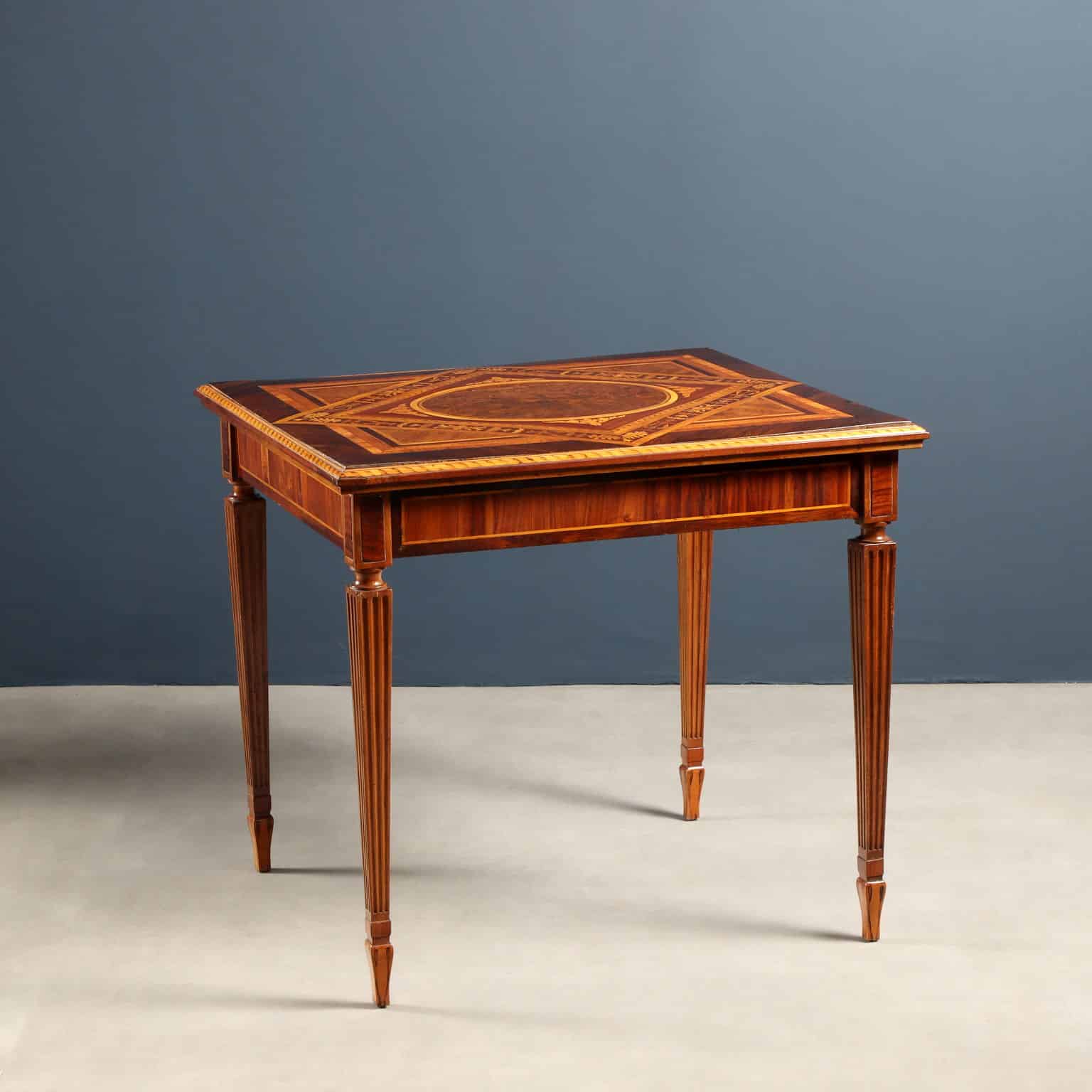
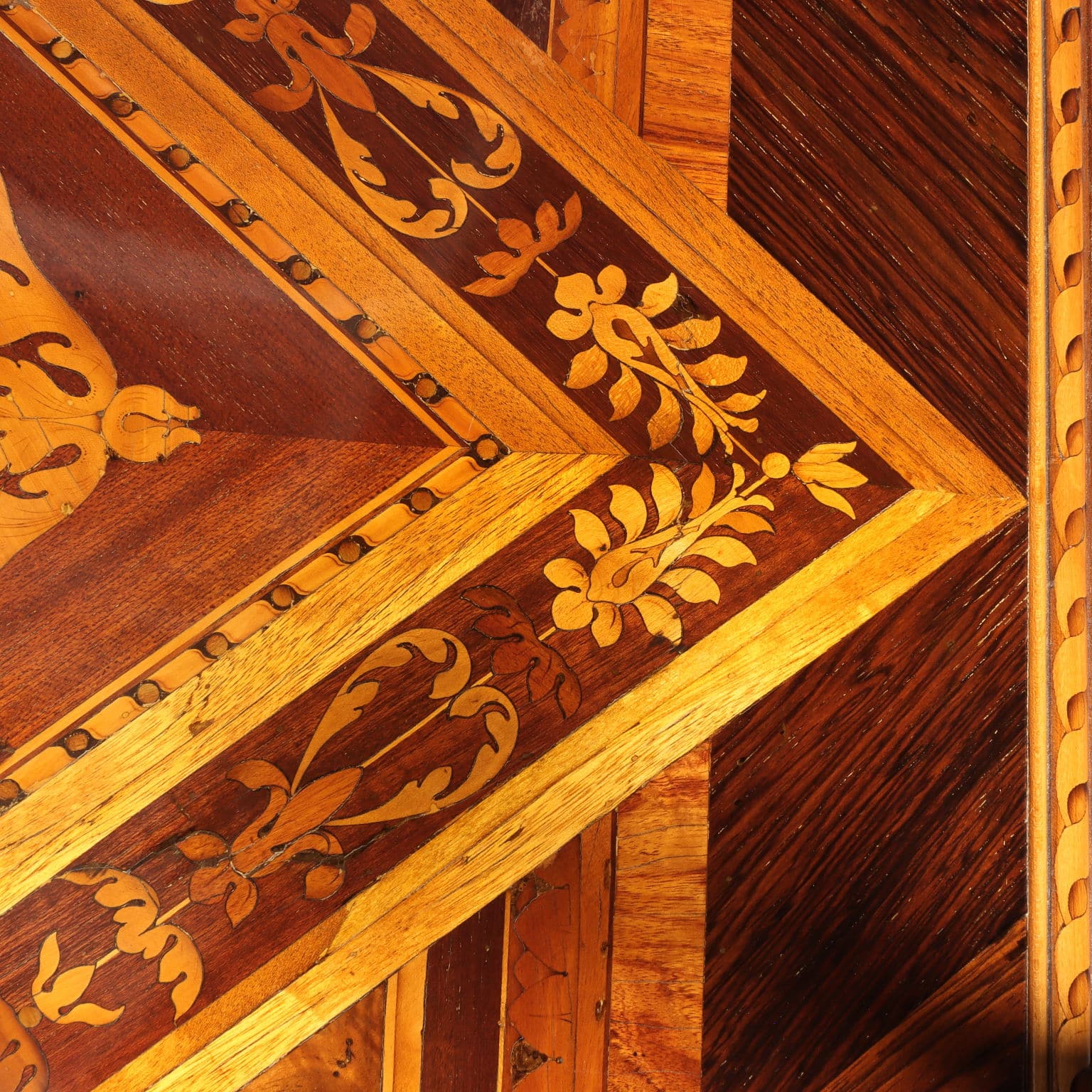
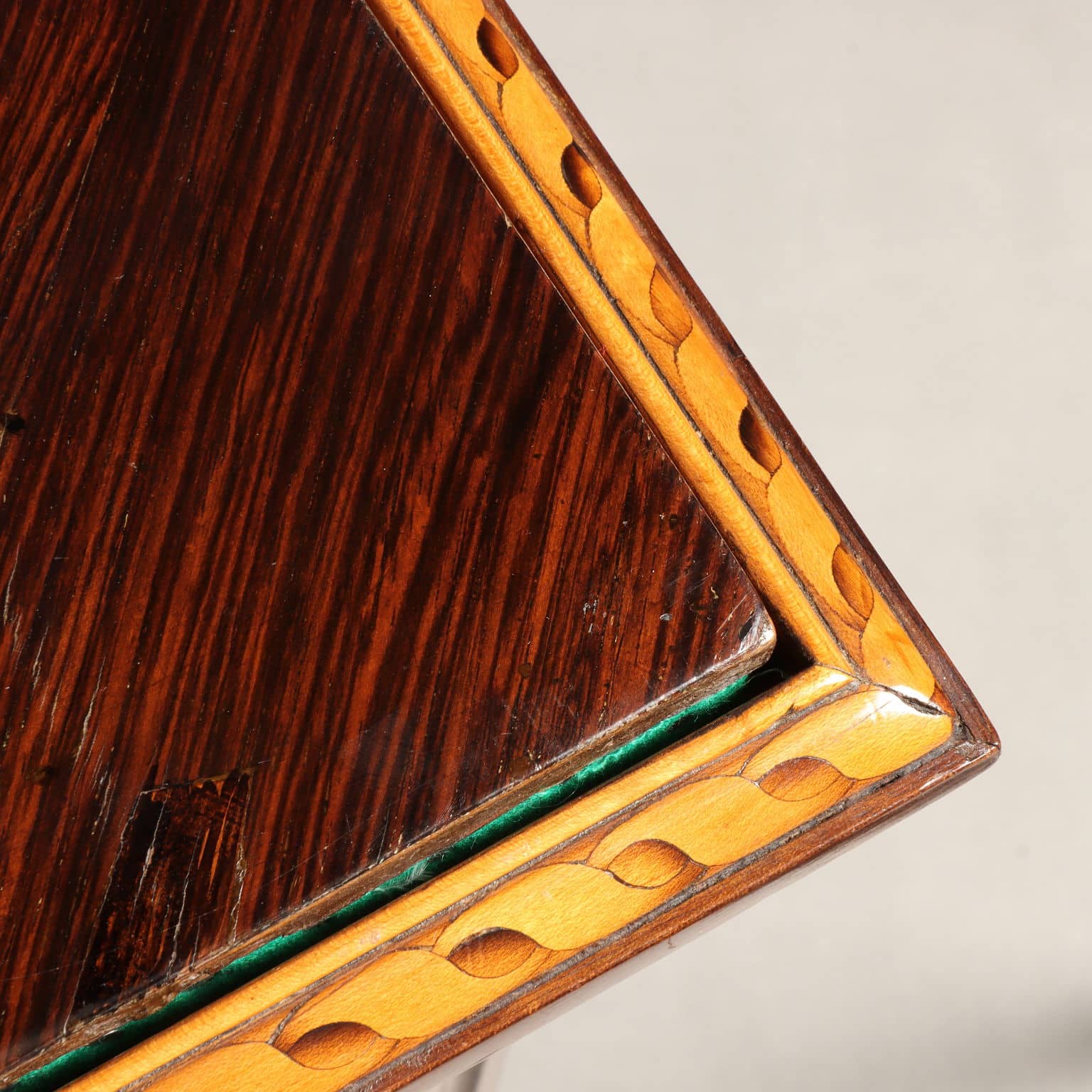
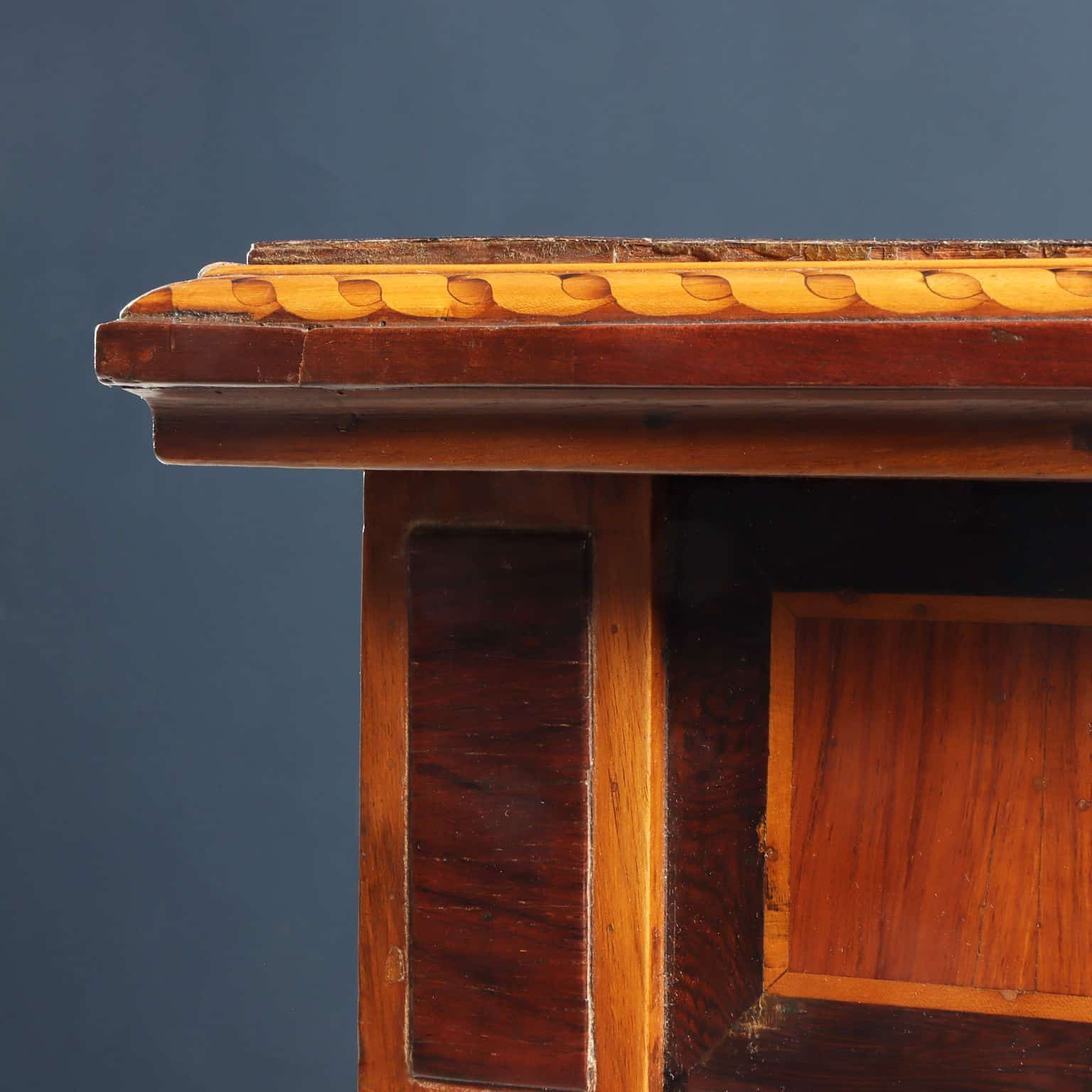
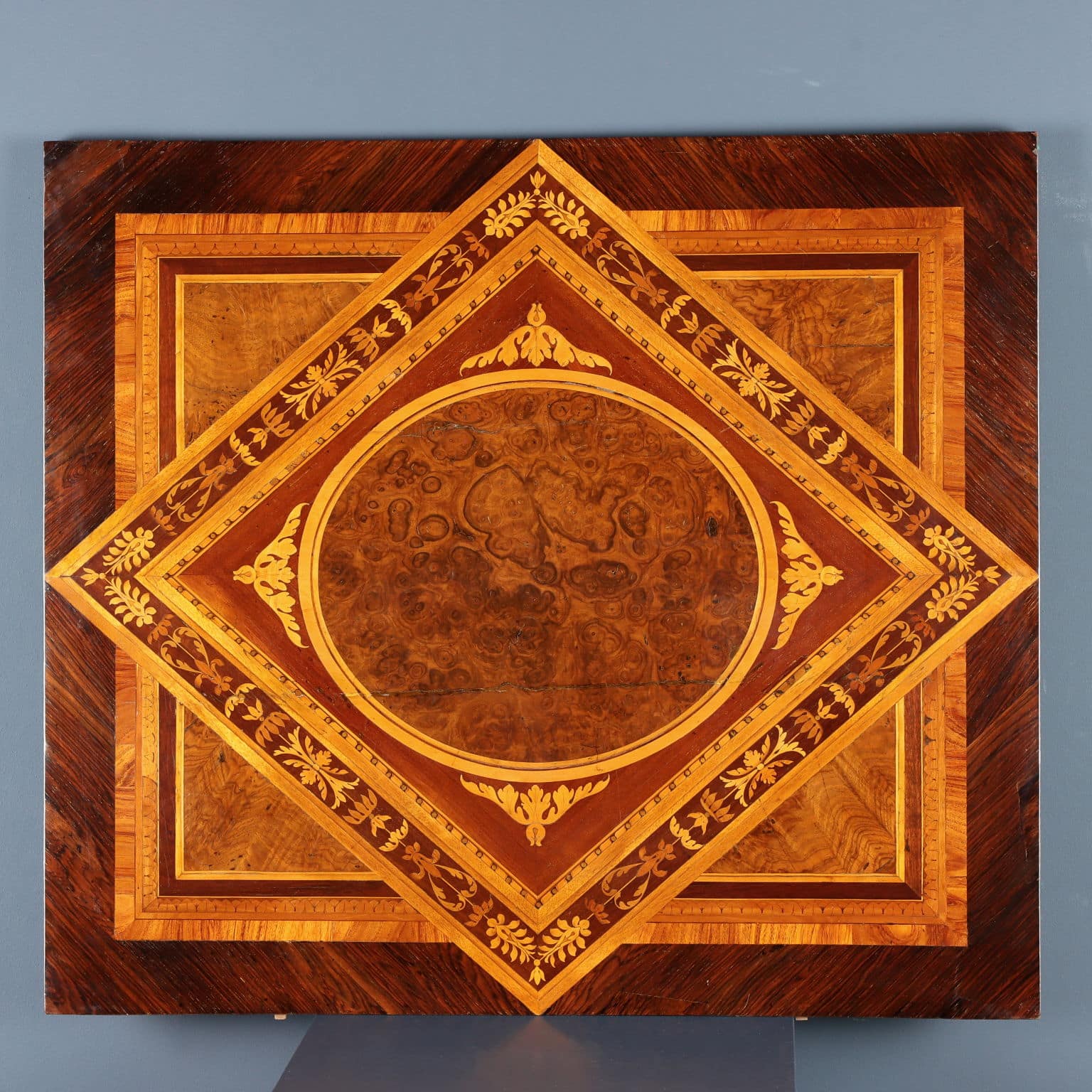
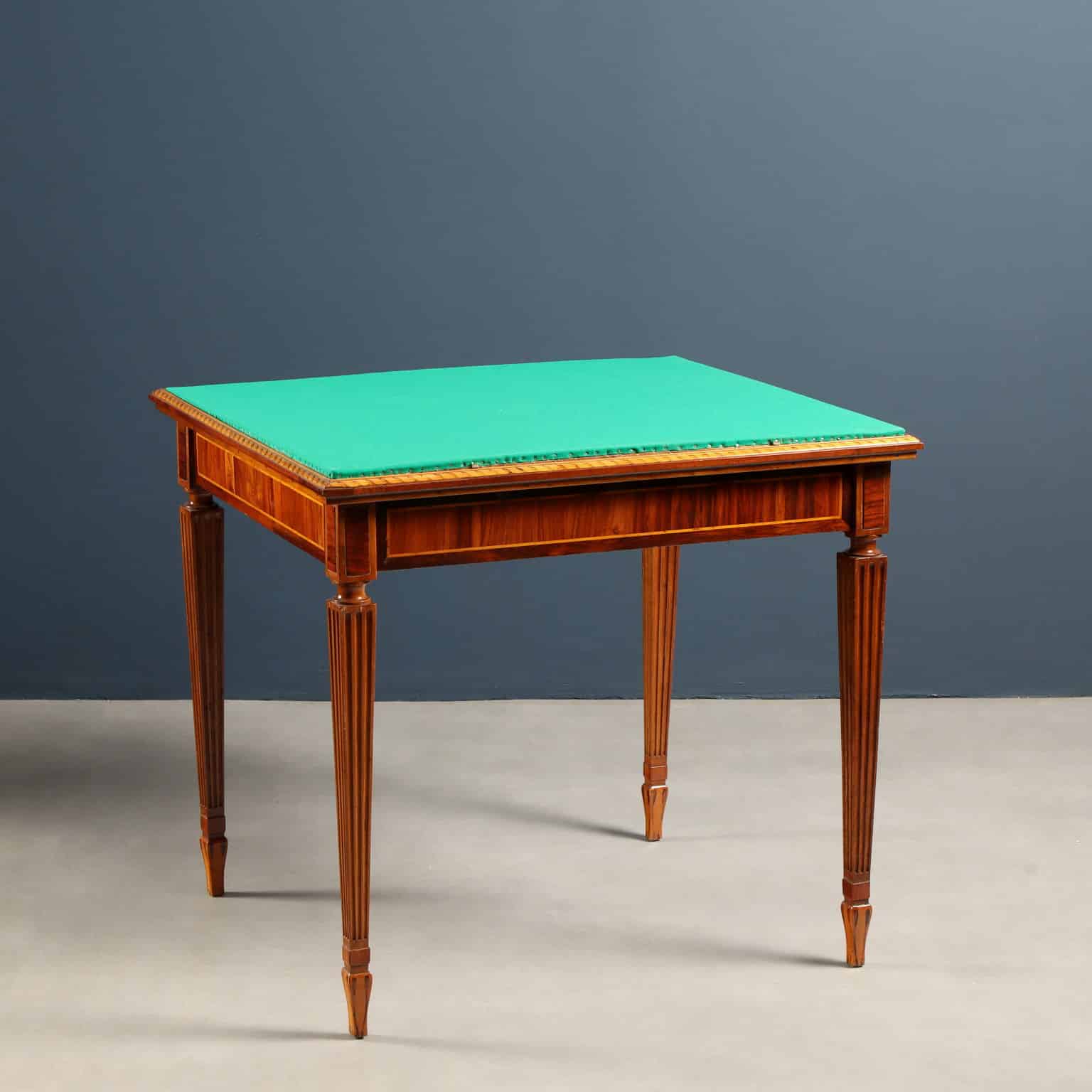
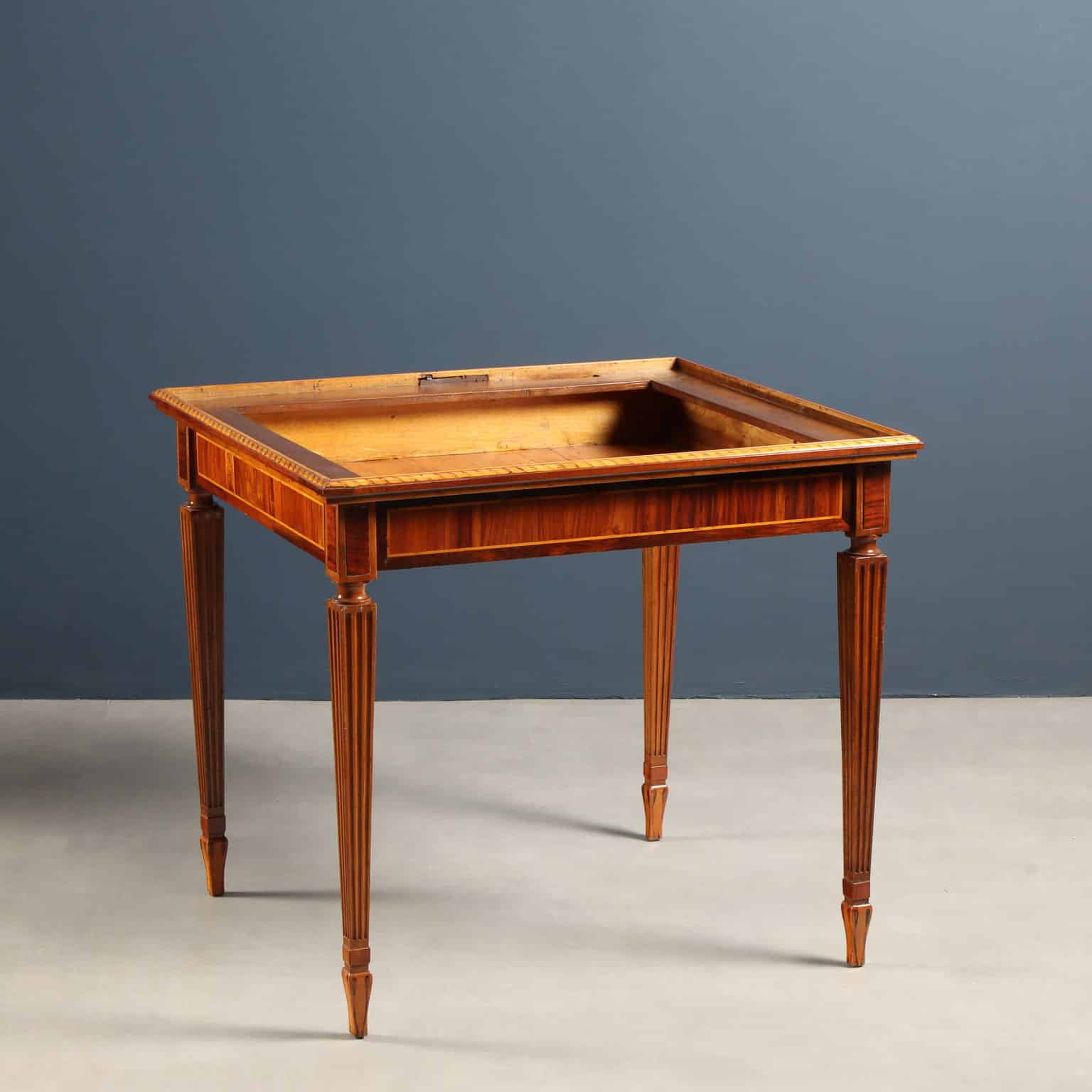
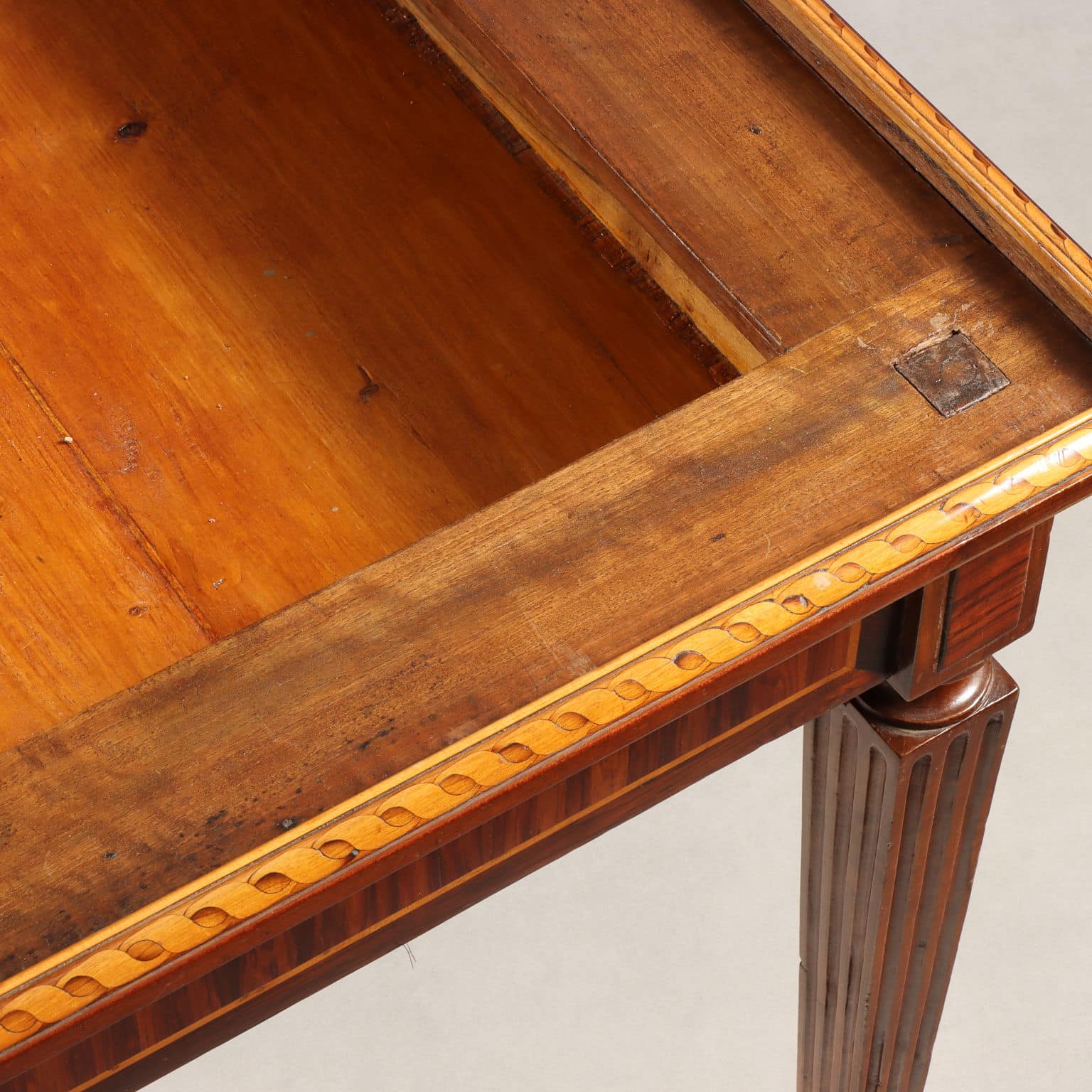
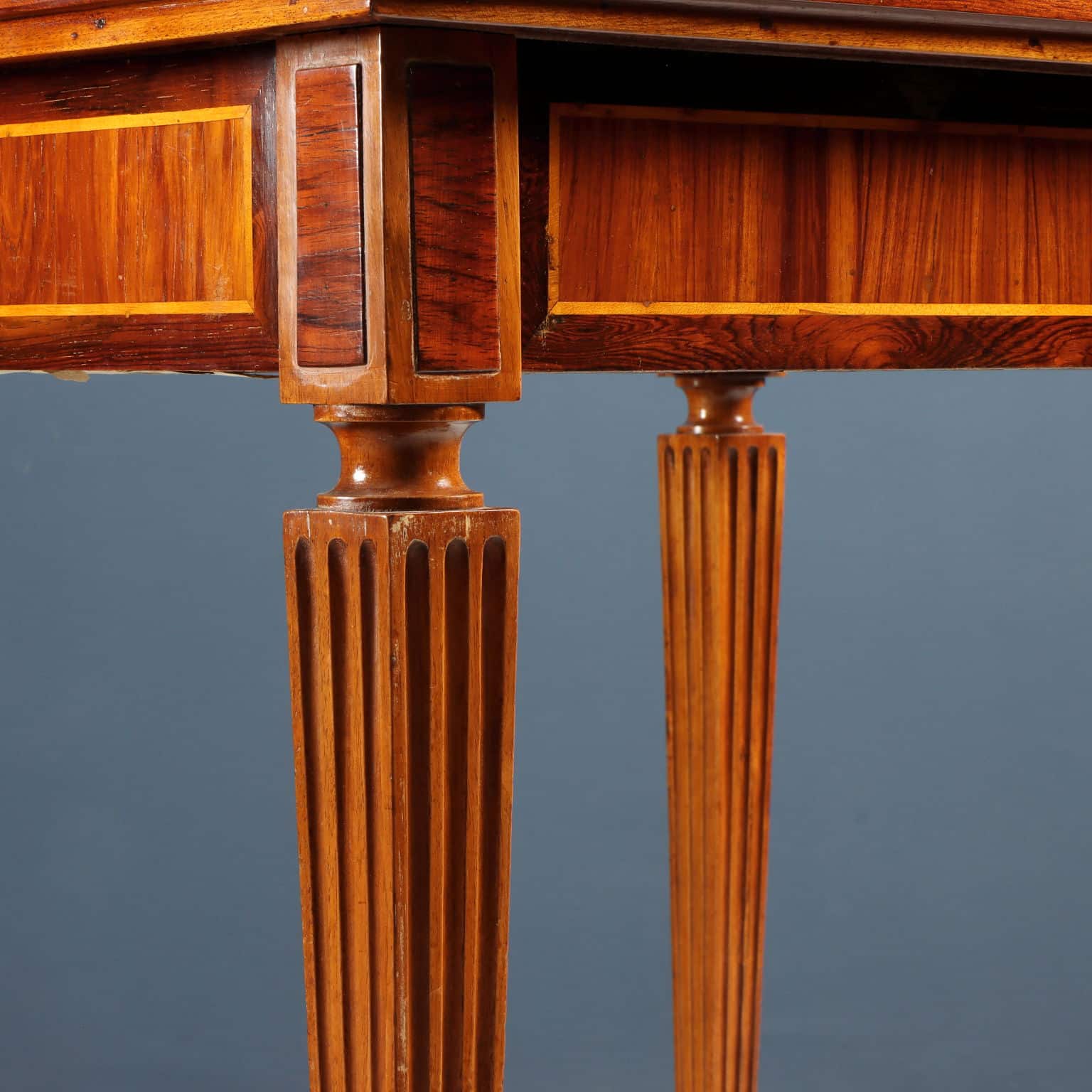
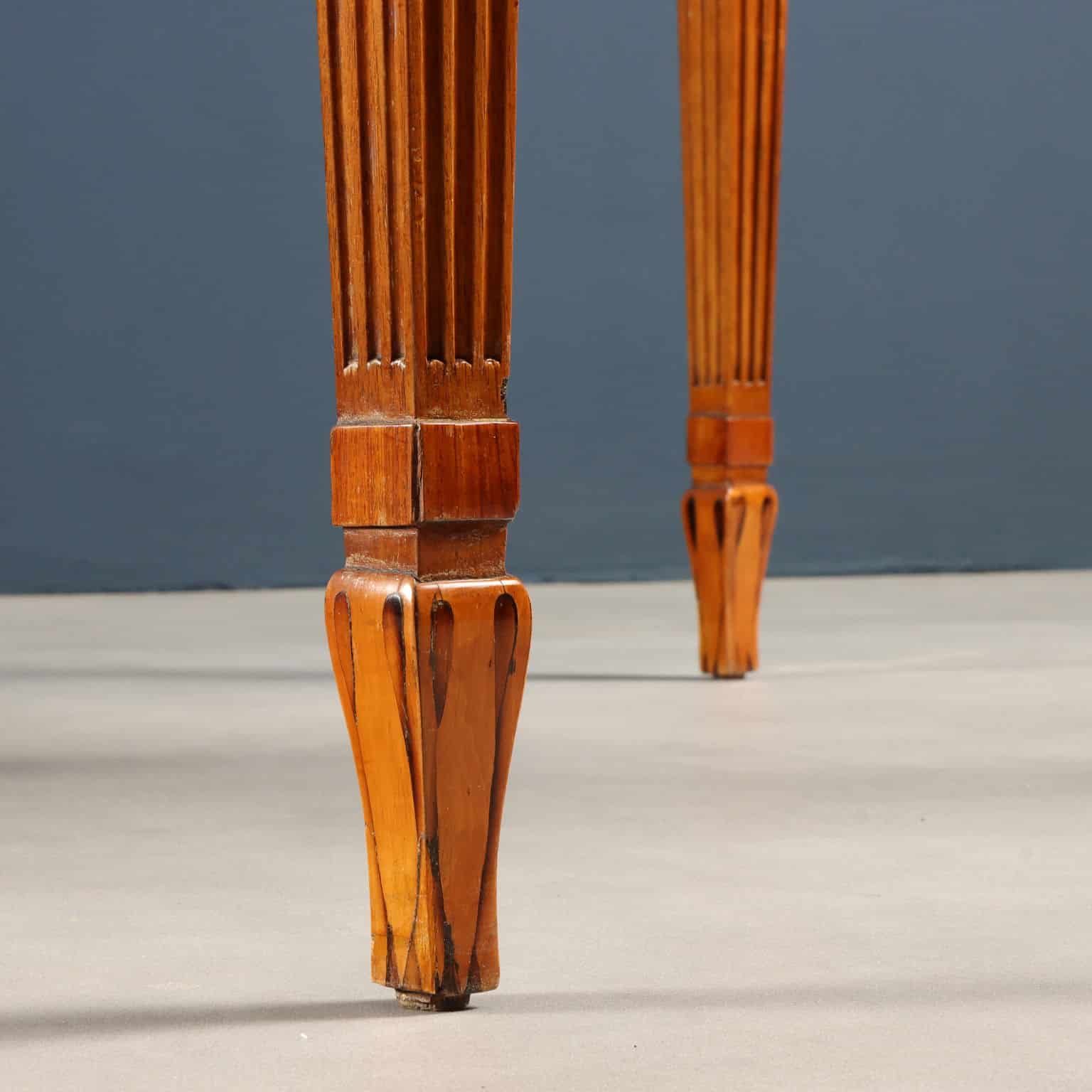
Rectangular games table raised on four tapered, truncated-pyramidal legs. The top, set within a frame, is fitted with a release spring that allows it either to be removed, providing access to the storage compartment concealed within the apron, or to be flipped over to reveal the baize-covered playing surface. The frame surrounding the top is inlaid with an interlacing ribbon border; the four fluted, truncated-pyramidal legs terminate in inlaid feet, while the aprons are decorated with simple reserved panels.
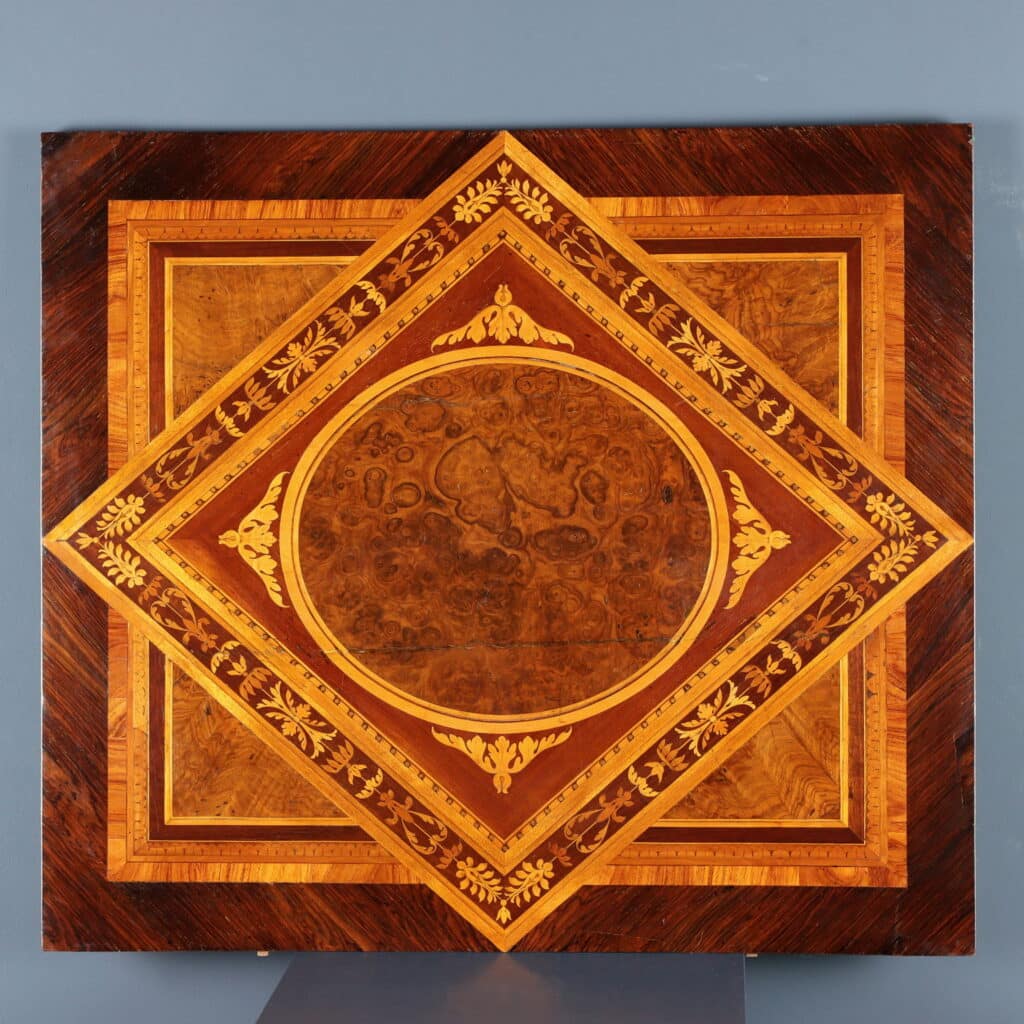
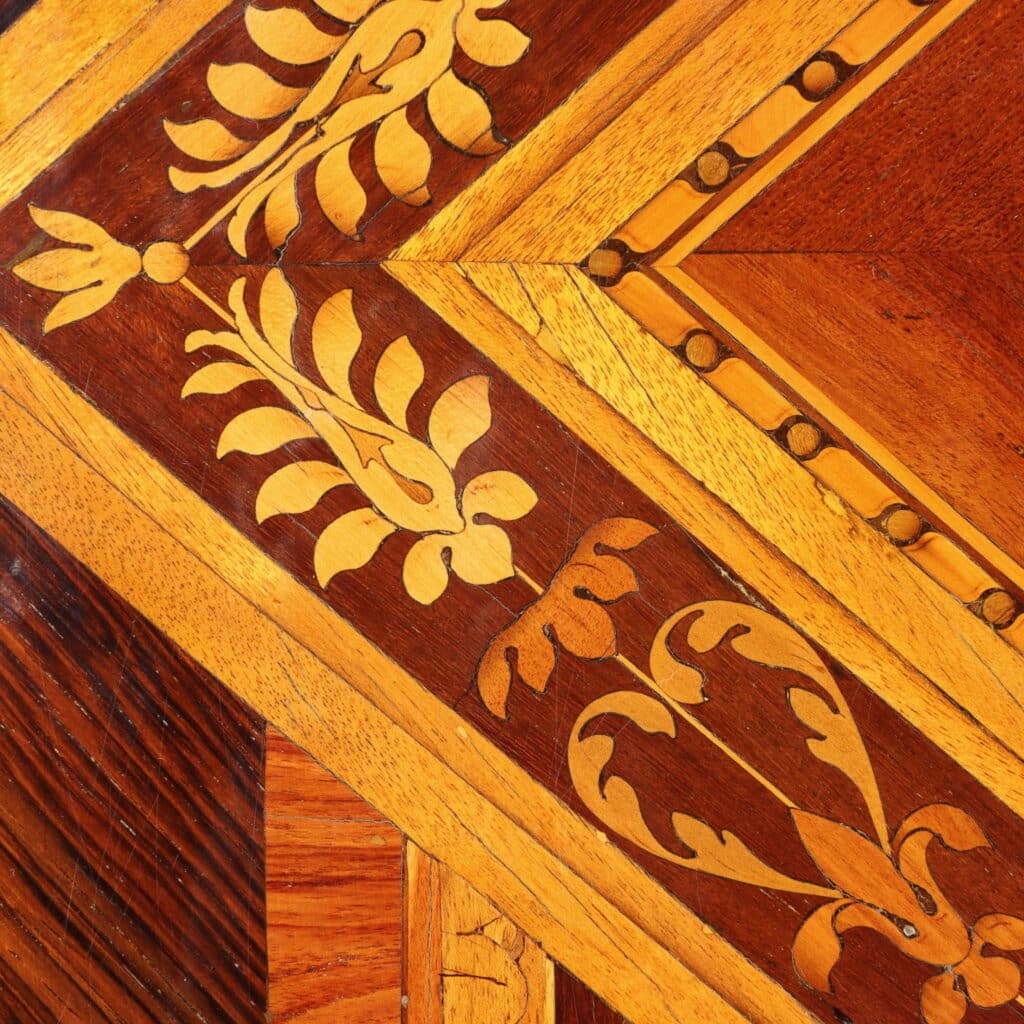
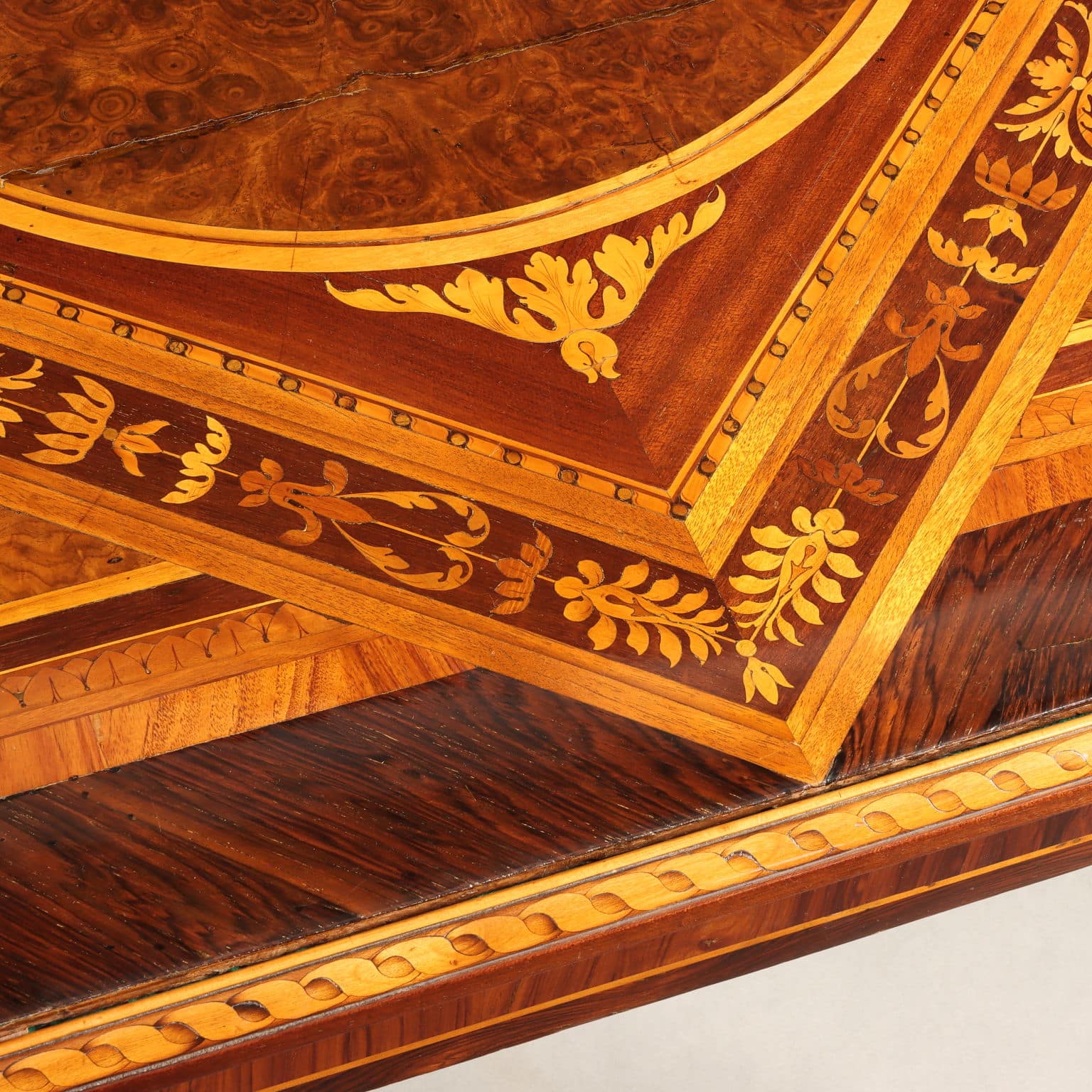
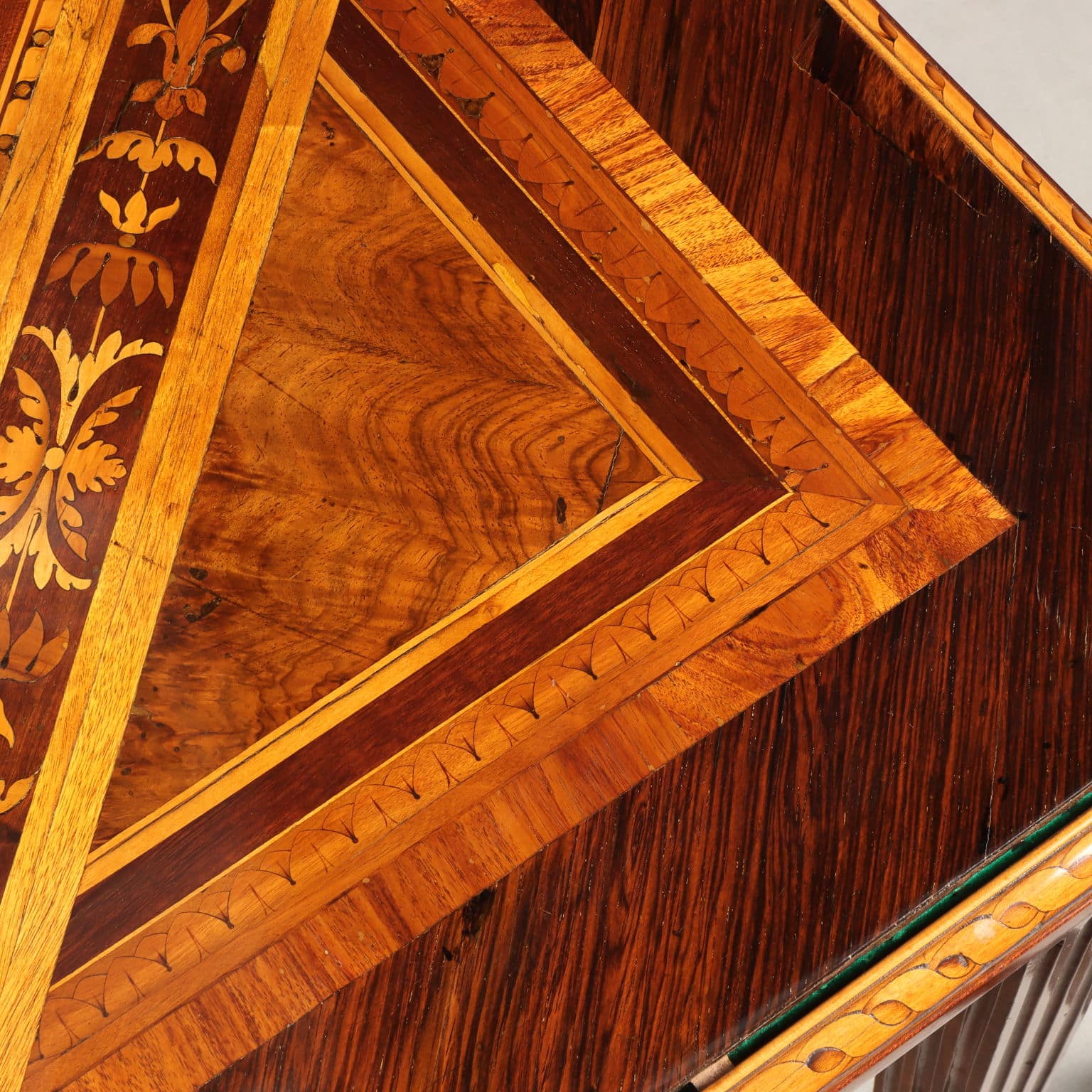
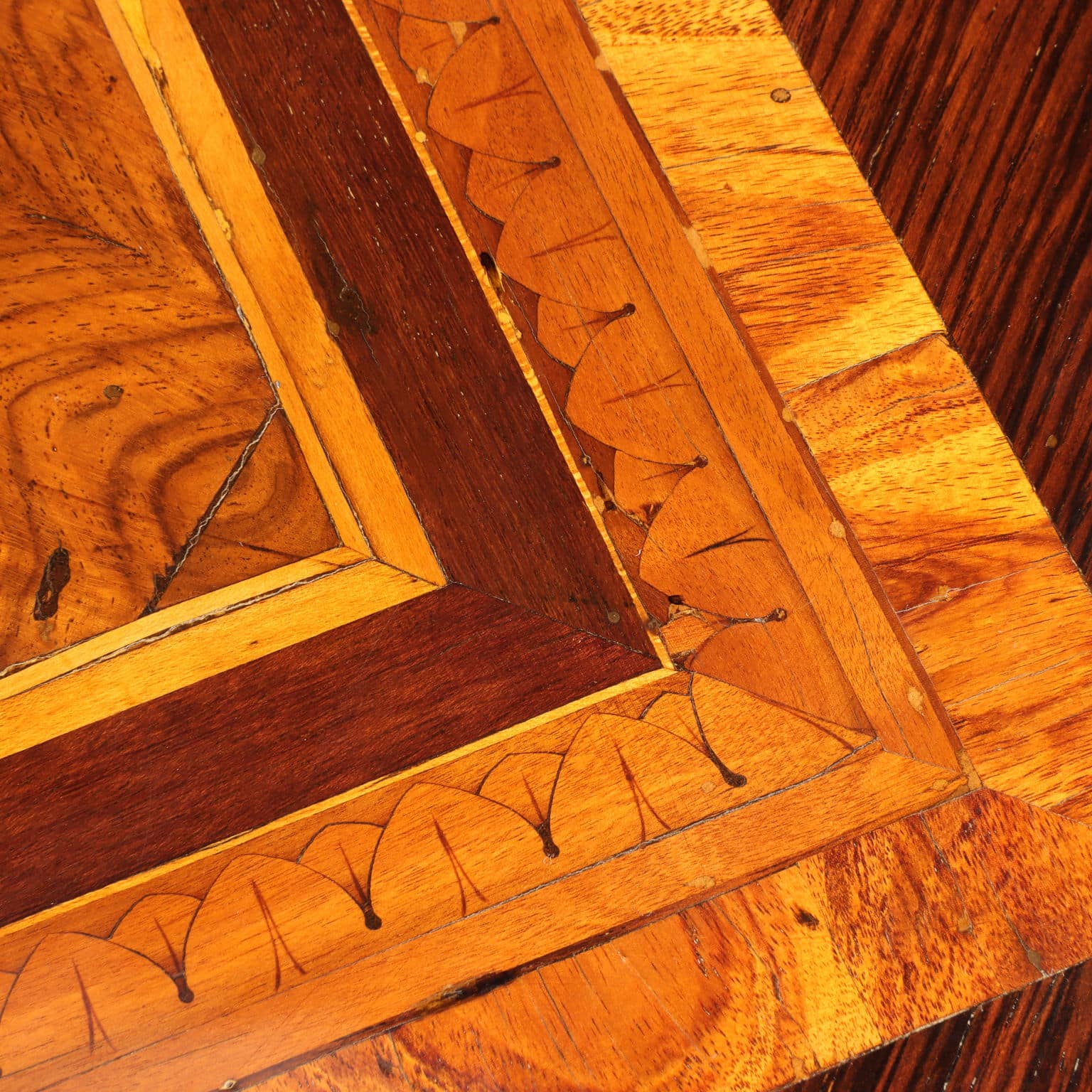
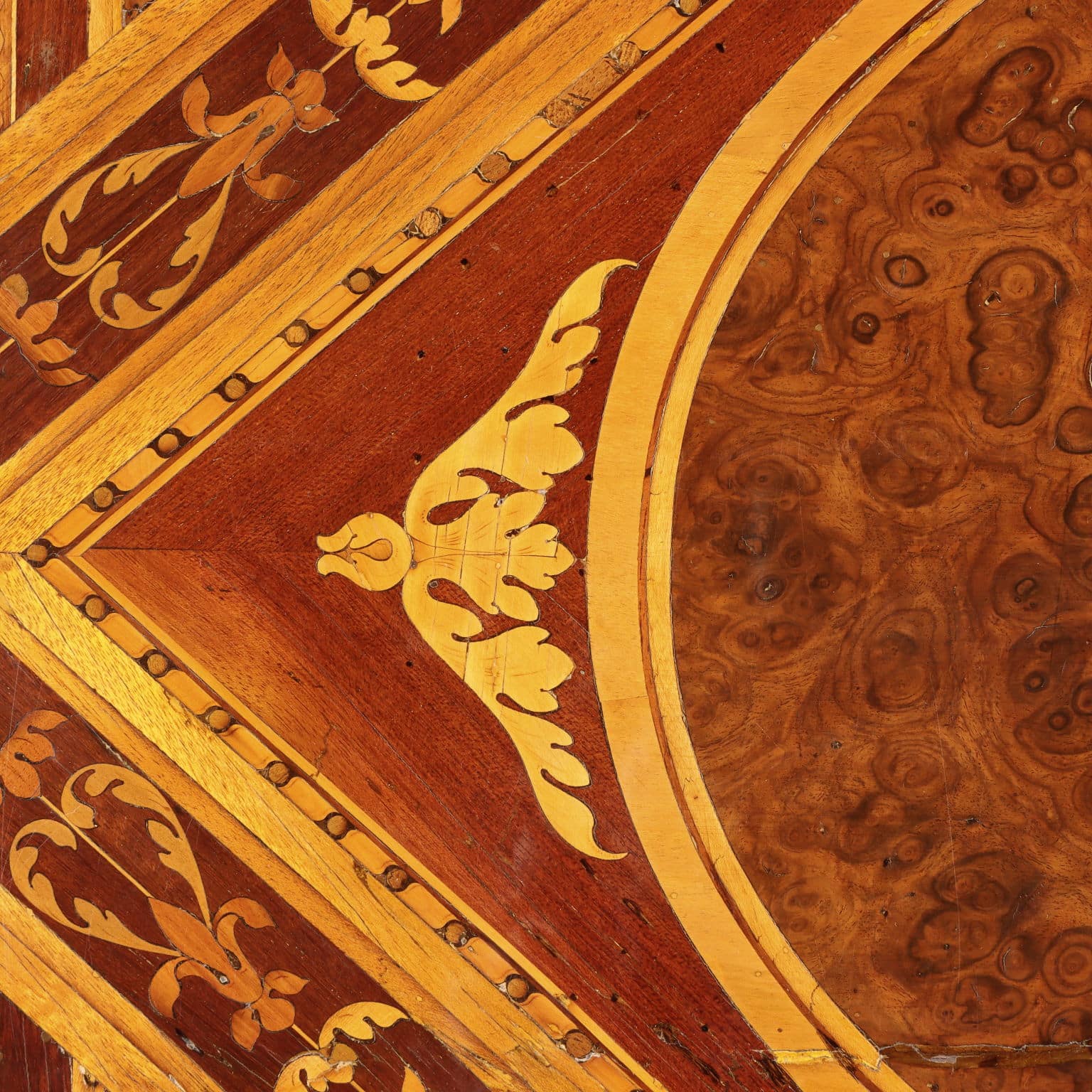
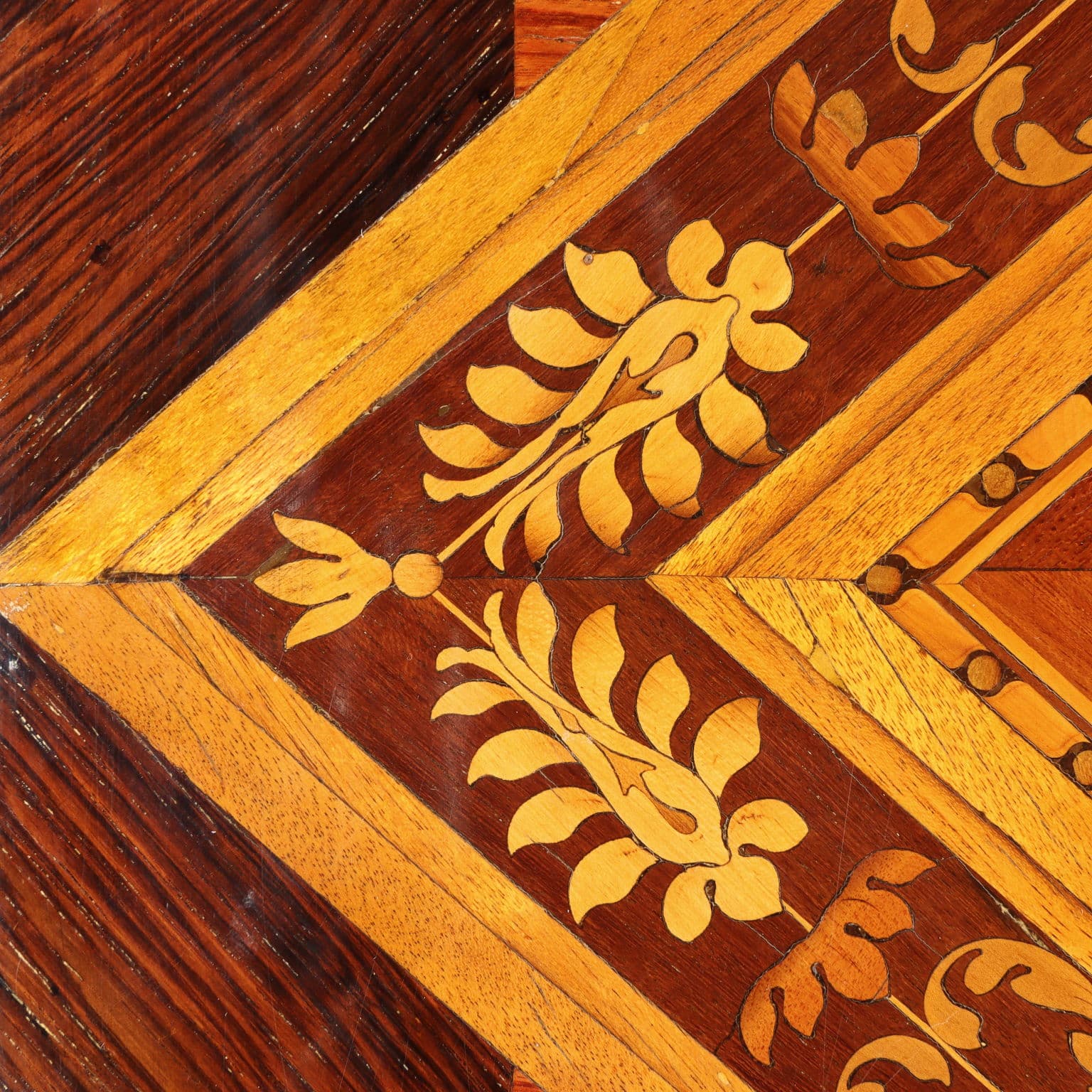
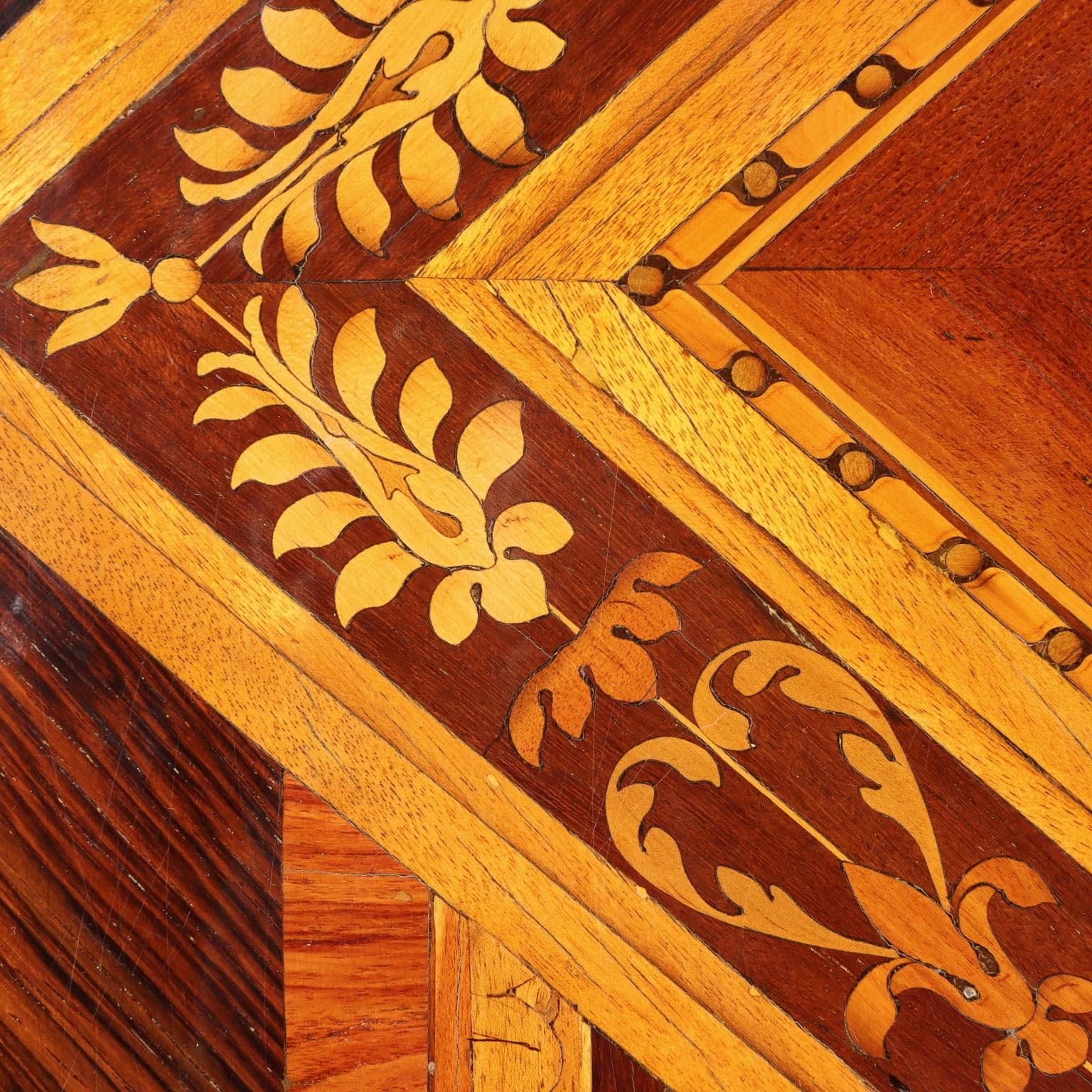
Of particular interest is the tabletop, which features an ingenious trompe-l’œil effect in which one square sheet, rendered in marquetry, appears to overlap another, creating elegant geometric reserves. The central panel, enclosed by an inlaid border of alternating anthemia and scrolling foliage, contains a large circular walnut burr medallion, with acanthus leaves inlaid at the corners. The table is veneered in bois de violette, bois de rose, walnut, mahogany, walnut burr, maple, and a variety of other woods used for the stringing and marquetry decoration.
Dimensions: 78 × 87 × 77 cm
Code: ANTATV0272241
Historical and Stylistic Analysis
As thoroughly documented by Giuseppe Beretti, during the early nineteenth century Giuseppe Maggiolini’s workshop produced a significant number of gaming tables, both for private patrons and for the Napoleonic court. Two principal types were made: folding tables with double tops, and fixed tables with reversible tops, such as the present example. A spring mechanism releases the top from its frame, allowing it to be turned over to expose the baize playing surface.
The dominant decorative feature of this table is the refined border composed of alternating acanthus leaves and anthemia, elegantly interwoven with one another. A design for this motif is preserved in the Fondo Maggiolini at the Gabinetto dei Disegni of Castello Sforzesco, where it is catalogued as FM B 470. The present table was published as plate 13 in the catalogue of the 1994 exhibition held at Brera.
In 1807, the Maggiolini workshop was commissioned to produce a remarkably large number of similar gaming tables for the Royal Palace of Monza, where approximately thirty examples are still preserved today. This explains why the Fondo Maggiolini contains such an extensive collection of drawings related to this type of furniture. As always, the quality of execution is exceptionally high and exemplifies the distinctive craftsmanship of the celebrated cabinetmaking workshop of Parabiago.
Comparative Bibliography:
Giuseppe Beretti, Giuseppe Maggiolini, l’Officina del Neoclassicismo, Malavasi 1994
Giuseppe Beretti, Officina Maggiolini, 1994, ed. Olivares
Giuseppe Beretti-Alvar Gonzalez Palacios, Giuseppe Maggiolini Catalogo ragionato dei disegni, ed. inlimine2014
Previous
Next
Game Table, Workshop of Giuseppe Maggiolini, Parabiago, Early 19th Century
Antiques, Art and Design
FineArt is the new ambitious Di Mano in Mano project that offers an exclusive choice of antiques and design works, presenting them for their singularity and uniqueness.
Contact us for more information or to make an appointment